Within UFO Prophecy
Did Failed Prophecy Really Strengthen Belief?
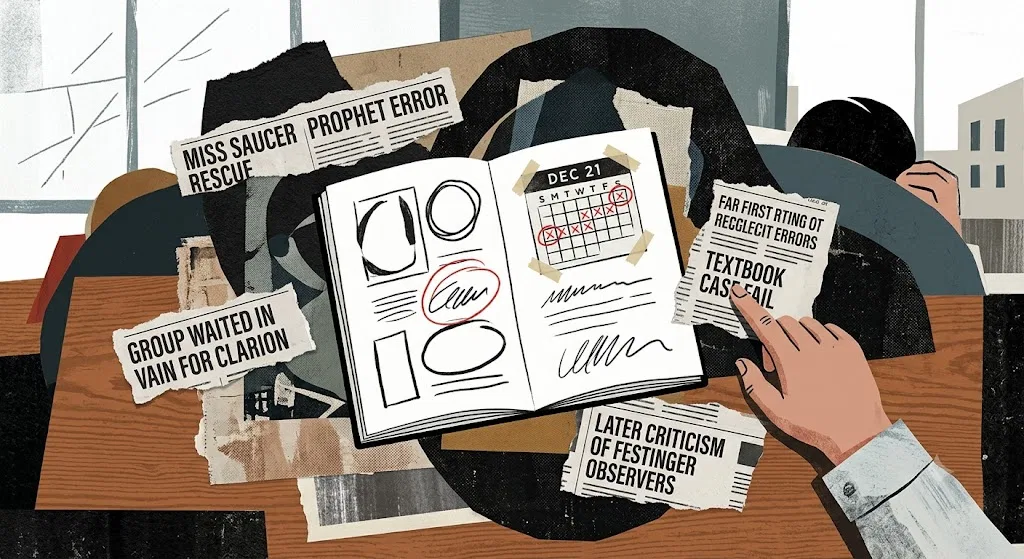
The famous psychology lesson from Martin's group is powerful, but later archival work shows a messier story than the textbook myth.
On this page
- The original cognitive dissonance claim
- What later criticism challenged
- What the case can and cannot prove
Page outline Jump by section
Introduction
When Prophecy Fails is the famous UFO-prophecy case that made cognitive dissonance feel almost like a law of human nature: believers expect alien rescue and a world-ending flood, the date passes, and instead of giving up they supposedly recruit harder. That lesson is still useful, but it is no longer safe to tell it as a clean parable. Later scholarship, especially newly available archival work, suggests the original account exaggerated or misrepresented key events, including whether the group really became more evangelical only after the failed prediction. The better lesson is narrower and more interesting: failed UFO prophecy can create psychological pressure to reinterpret events, but it does not automatically strengthen belief, and the Martin case cannot bear all the weight that textbooks have placed on it.[Semantic Scholar+2PubMed]semanticscholar.orgSemantic Scholar[PDF] When Prophecy Fails | Semantic ScholarSemantic Scholar[PDF] When Prophecy Fails | Semantic Scholar
The original cognitive dissonance claim
Leon Festinger, Henry Riecken and Stanley Schachter studied a small 1954 UFO-contactee group centred on Dorothy Martin, called “Marian Keech” in their book. Martin claimed to receive messages from beings associated with the planet Clarion, warning that a great flood would devastate much of Earth on 21 December 1954. A select group, she said, would be saved by spacecraft. Local accounts preserve the same basic pattern: a dated catastrophe, a promised rescue, and followers waiting through the night when nothing happened.[Oak Park River Forest Museum]oprfmuseum.orgOpen source on oprfmuseum.org.
The psychological claim was not simply that the group was wrong. It was that a costly, public, emotionally loaded belief can become harder to abandon after disconfirmation. In the researchers’ telling, some followers had invested heavily: leaving work, disrupting family life, giving away possessions, or publicly tying their reputation to the prophecy. When the saucer did not arrive and the flood did not come, that created cognitive dissonance: the discomfort of holding a belief that reality has just contradicted.[The New Yorker]newyorker.comThe New Yorker Is Cognitive Dissonance Actually a Thing? | The New YorkerThe New Yorker Is Cognitive Dissonance Actually a Thing? | The New Yorker
The famous resolution was social. According to the book’s interpretation, believers could reduce dissonance by persuading others. If more people accepted the message, the failed prophecy could be reframed not as error but as proof that the group’s faith had helped avert disaster. The story therefore became a memorable mechanism for failed UFO predictions generally: when a predicted landing, rescue or revelation fails, believers may shift from “the event will happen” to “our faith changed the event”, “the event happened invisibly”, or “the test was spiritual rather than physical”.[Semantic Scholar]semanticscholar.orgSemantic Scholar[PDF] When Prophecy Fails | Semantic ScholarSemantic Scholar[PDF] When Prophecy Fails | Semantic Scholar
That is why the case travelled so far beyond UFO studies. It gave psychologists, sociologists of religion and later commentators a compact model for belief under pressure: the more a person has sacrificed for a prediction, and the more social support remains around them, the more attractive reinterpretation can become.
What later criticism challenged
The textbook version now has a serious problem: the original study was not a detached observation of an untouched group. Festinger and his colleagues infiltrated the circle, and later discussion has long noted that observers, journalists and outside attention may have shaped the very behaviour being explained. Lorne Dawson’s review of failed-prophecy research argued that the field should move away from treating Festinger’s formulation as the whole story and towards a broader view of how groups manage disconfirmation in different ways.[Gwern]gwern.net1999 dawson1999 dawson
The strongest recent challenge comes from Thomas Kelly’s archival work. PubMed’s abstract of Kelly’s article summarises the claim sharply: newly unsealed material indicates that the book’s central claims were false, that the group had proselytised before the failure, and that the group quickly abandoned key beliefs afterwards. It also reports allegations of serious ethical violations, including fabricated psychic messages, covert manipulation and interference in a child welfare investigation.[PubMed]pubmed.ncbi.nlm.nih.govPub Med Debunking "When Prophecy FailsDebunking "When Prophecy Fails" - PubMed…
A detailed contemporary account in The New Yorker adds why this matters for the mechanism. It reports that some meetings may have included a large proportion of infiltrators, that one research assistant pretended to receive dreams and psychic messages, and that Henry Riecken held unusual status inside the group. On that account, the researchers did not merely watch dissonance unfold; they may have helped create the social cues that made the aftermath look like their theory.[The New Yorker]newyorker.comThe New Yorker Is Cognitive Dissonance Actually a Thing? | The New YorkerThe New Yorker Is Cognitive Dissonance Actually a Thing? | The New Yorker
The most damaging issue is timing. The classic claim depends on a contrast: secrecy before failure, energetic recruitment after failure. But later archival discussion points to outreach before the failed date, including magazine writing, a press release, public claims by Charles Laughead and prior media attention. If proselytising was already happening, then post-failure publicity cannot be treated as clean evidence that disconfirmation caused a new evangelising drive.[The New Yorker]newyorker.comThe New Yorker Is Cognitive Dissonance Actually a Thing? | The New YorkerThe New Yorker Is Cognitive Dissonance Actually a Thing? | The New Yorker
This does not mean every idea associated with cognitive dissonance collapses. It means this particular UFO-prophecy case is weaker than its legend. Even defenders of dissonance theory have treated When Prophecy Fails as an evocative but methodologically fragile example rather than a controlled test. Elliot Aronson, one of Festinger’s students, is reported as saying that the observational case would not by itself decide the fate of the wider theory, which also rests on laboratory studies and later research.[The New Yorker]newyorker.comThe New Yorker Is Cognitive Dissonance Actually a Thing? | The New YorkerThe New Yorker Is Cognitive Dissonance Actually a Thing? | The New Yorker
Why the “stronger after failure” myth is too simple
The most persistent misunderstanding is that failed prophecy naturally makes believers more certain. The Martin case actually points to several different possibilities. Some people may reinterpret the failure. Some may quietly drift away. Some may preserve the wider spiritual worldview while dropping the specific prediction. Some may blame human error, timing, outsiders, hidden fulfilment or a changed divine or alien plan.
That range matters for UFO prophecy because the failed event is often only one layer of belief. A believer may stop expecting a rescue on a named date while still believing in telepathic contact, cosmic masters, hidden spacecraft or a coming transformation. Martin herself did not simply become a conventional sceptic. After the 1954 episode, she continued as Sister Thedra and later founded the Association of Sananda and Sanat Kumara, an organisation rooted in continuing channelled teachings and the contactee milieu.[Encyclopedia.com]encyclopedia.comAssociation of Sananda and Sanat Kumara | Encyclopedia.comAssociation of Sananda and Sanat Kumara | Encyclopedia.com
The case therefore separates three things that are often blurred together:
- The dated prediction failed. No flood destroyed the world on 21 December 1954, and no public flying-saucer rescue occurred.
- The original group did not necessarily strengthen in the simple textbook way. Later archival work challenges the claim that failure produced a clear new wave of recruitment.
- The wider belief world survived in altered form. Martin’s later channelled religion shows that abandoning one prediction is not the same as abandoning the whole metaphysical system.
That distinction is crucial for understanding failed UFO predictions. “Belief persisted” may be true in one sense and false in another. A failed saucer rescue can end a local group, damage a specific prophecy and still leave the believer’s larger cosmic framework intact.
What the case can and cannot prove
The Martin case can still teach a useful mechanism: when people are publicly committed to a failed prediction, they often look for ways to reduce the psychological and social cost of being wrong. Reinterpretation is one such route. Recruitment can be another, because agreement from outsiders turns private embarrassment into shared validation. Social support also matters: a believer surrounded by fellow believers has more resources for reinterpretation than an isolated follower facing ridicule alone.[Gwern]gwern.net1999 dawson1999 dawson
But the case cannot prove that failed UFO prophecy usually strengthens belief. The evidence is too contaminated by observer involvement, press pressure and later disputes over what actually happened. It is safer to treat the original book as a historically important prompt for a theory, not as a clean demonstration of that theory.[PubMed]pubmed.ncbi.nlm.nih.govPub Med Debunking "When Prophecy FailsDebunking "When Prophecy Fails" - PubMed…
It also cannot show that cognitive dissonance predicts one outcome. Dissonance is a pressure, not a script. The same failed prediction may produce renewed zeal in one person, embarrassment in another, reinterpretation in a third and quiet exit in a fourth. That is why Dawson’s broader framing is useful: failed-prophecy research works best when it studies the practical strategies groups use to manage disconfirmation, rather than assuming one universal response.[Gwern]gwern.net1999 dawson1999 dawson
For readers following failed UFO predictions, the practical takeaway is to watch the repair work after the date passes. Does the claim become less physical and more spiritual? Does the group say disaster was averted by faith? Does leadership blame timing, translation, human weakness or hostile forces? Do members recruit harder, retreat inward or disperse? Those responses tell us more than the failed date alone.
The enduring value of When Prophecy Fails is therefore not the tidy slogan that failure strengthens belief. Its value is the messier warning that failed predictions do not interpret themselves. People, groups, researchers and later storytellers all compete to decide what the failure means.
Amazon book picks
Further Reading
Books and field guides related to Did Failed Prophecy Really Strengthen Belief?. Use these as the next step if you want deeper reading beyond the article.
When Prophecy Fails
The article centers on the famous failed-prophecy case study and later criticism of its conclusions.
A Theory of Cognitive Dissonance
Provides the original theoretical framework behind interpretations of failed prophecy and belief persistence.
The Believing Brain
Explores how people form, defend, and rationalize beliefs even when evidence is weak or contradictory.

Mistakes Were Made (But Not by Me)
Explains cognitive dissonance, self-justification, and why people maintain beliefs after contradictory evidence.
eBay marketplace picks
Marketplace Samples
Example marketplace items related to this page. Use the search link to explore similar finds on eBay.




Endnotes
1.
Source: gwern.net
Title: 1999 dawson
Link:https://gwern.net/doc/sociology/1999-dawson.pdf
2.
Source: encyclopedia.com
Title: Association of Sananda and Sanat Kumara | Encyclopedia.com
Link:https://www.encyclopedia.com/science/encyclopedias-almanacs-transcripts-and-maps/association-sananda-and-sanat-kumara
3.
Source: leon.co
Link:https://leon.co/
Source snippet
HomepageMeals in Minutes. Our Microwave Meal Pouches are inspired by our restaurant menu. Each pouch is packed with flavour, plant...
4.
Source: gwern.net
Link:https://gwern.net/doc/psychology/cognitive-bias/2025-kelly.pdf
5.
Source: youtube.com
Title: Cognitive Dissonance Theory: A Crash Course
Link:http://www.youtube.com/watch?v=9Y17YaZRRvY
Source snippet
Leon Festinger...
6.
Source: youtube.com
Title: Leon Festinger
Link:http://www.youtube.com/watch?v=lPM17X4CXzc
Source snippet
When Prophecy Fails: Cognitive Dissonance & the "Trump Re-Election" Prophecies...
7.
Source: semanticscholar.org
Title: Semantic Scholar[PDF] When Prophecy Fails | Semantic Scholar
Link:https://www.semanticscholar.org/paper/When-Prophecy-Fails-Festinger-Riecken/1df350a8638ab04f6a2f08623646a40d56dbb40c
8.
Source: pubmed.ncbi.nlm.nih.gov
Title: Pub Med Debunking “When Prophecy Fails”
Link:https://pubmed.ncbi.nlm.nih.gov/41186060/
Source snippet
Debunking "When Prophecy Fails" - PubMed...
9.
Source: newyorker.com
Title: The New Yorker Is Cognitive Dissonance Actually a Thing? | The New Yorker
Link:https://www.newyorker.com/culture/the-lede/is-cognitive-dissonance-actually-a-thing
10.
Source: oprfmuseum.org
Link:https://oprfmuseum.org/this-month-in-history/seekers-cuyler-avenue
11.
Source: Wikipedia
Title: When Prophecy Fails
Link:https://en.wikipedia.org/wiki/When_Prophecy_Fails
12.
Source: libris.nl
Title: When Prophecy Fails
Link:https://libris.nl/librisbuitelaar/a/professor-leon-festinger–henry-w-riecken–stanley-schachter/when-prophecy-fails/9781617202803
13.
Source: denieuweboekhandel.nl
Title: When Prophecy Fails
Link:https://denieuweboekhandel.nl/products/when-prophecy-fails-9781617202803
Additional References
14.
Source: youtube.com
Title: When Prophecy Fails: Cognitive Dissonance & the “Trump Re-Election” Prophecies
Link:http://www.youtube.com/watch?v=uIcIj_Iwvp4
Source snippet
When Prophecy Fails Leon Festinger cognitive dissonance theory Cognitive Dissonance Theory: A Crash Course Opinion Science...
15.
Source: bps.org.uk
Title: when when prophecy fails fails
Link:https://www.bps.org.uk/psychologist/when-when-prophecy-fails-fails
Source snippet
When 'when prophecy fails' fails | BPS10 Mar 2026 — According to the researchers, the cult responded to the failure of their prophecy by...
16.
Source: youtube.com
Title: End of Days Cults, the Day After | Cognitive Dissonance
Link:http://www.youtube.com/watch?v=5yVuauQjkDc
Source snippet
Festinger's When Prophecy Fails: What Happens After the World Doesn't End...
17.
Source: youtube.com
Title: Festinger’s When Prophecy Fails: What Happens After the World Doesn’t End
Link:http://www.youtube.com/watch?v=bkRjQ5juZXk
Source snippet
Cognitive Dissonance Theory: A Crash Course...
18.
Source: researchgate.net
Link:https://www.researchgate.net/publication/397254906_Debunking_When_Prophecy_Fails
19.
Source: goodreads.com
Link:https://www.goodreads.com/work/editions/19317-in-the-name-of-science
20.
Source: amazon.com
Link:https://www.amazon.com/Fads-Fallacies-Name-Science-Popular-ebook/dp/B00A73ITVW?tag=searcht-20
21.
Source: openlibrary.org
Link:https://openlibrary.org/works/OL459956W/In_the_Name_of_Science
22.
Source: facebook.com
Link:https://www.facebook.com/CCHPsych/posts/the-henry-w-riecken-papers-are-newly-processed-and-available-for-research-riecke/1564839975641518/
23.
Source: amazon.co.uk
Link:https://www.amazon.co.uk/Leon-Ingredients-Recipes/dp/1840915021?tag=searcht-20
Topic Tree
Follow this branch
Parent topic
UFO ProphecyRelated pages 29
- Many Outcomes Failure Does Not Make Everyone Believe Harder
- Observer Effect When the Study Changed the Story
- Public Sacrifice When Being Wrong Costs Too Much
- Recruitment Claim The Before and After Story That May Not Hold
- Sister Thedra When the Date Fails but the Worldview Survives
- +1 more in sidebar