Within Media
Did the Famous Saucer Group Really Double Down?
Dorothy Martin's saucer rescue story became a famous lesson about belief, but the media setting complicates the usual doubling-down narrative.
On this page
- How reporters and spectators entered the event
- Why the classic dissonance story became memorable
- What later criticism changes about the lesson
Page outline Jump by section
Introduction
Dorothy Martin’s 1954 flying-saucer rescue prophecy is usually remembered through a single lesson: when a prediction failed, believers supposedly doubled down and became even more committed. That version became one of the most famous examples in psychology through When Prophecy Fails by Leon Festinger, Henry Riecken and Stanley Schachter. Yet the event was also a media spectacle, a heavily observed social drama in which reporters, curious spectators, police, and undercover researchers were not merely recording events but helping shape them. Later scholarship has argued that the standard story became famous partly because it fit a powerful psychological theory, while important details about publicity, observation, and the group’s actual aftermath were pushed into the background.[Wikipedia]WikipediaWhen Prophecy FailsWhen Prophecy Fails
 Understanding Martin’s case therefore requires looking beyond the simple “they doubled down” narrative and asking how public attention transformed a small UFO movement into a lasting cultural legend.[Wikipedia]WikipediaWhen Prophecy FailsWhen Prophecy Fails
How Reporters and Spectators Entered the Event
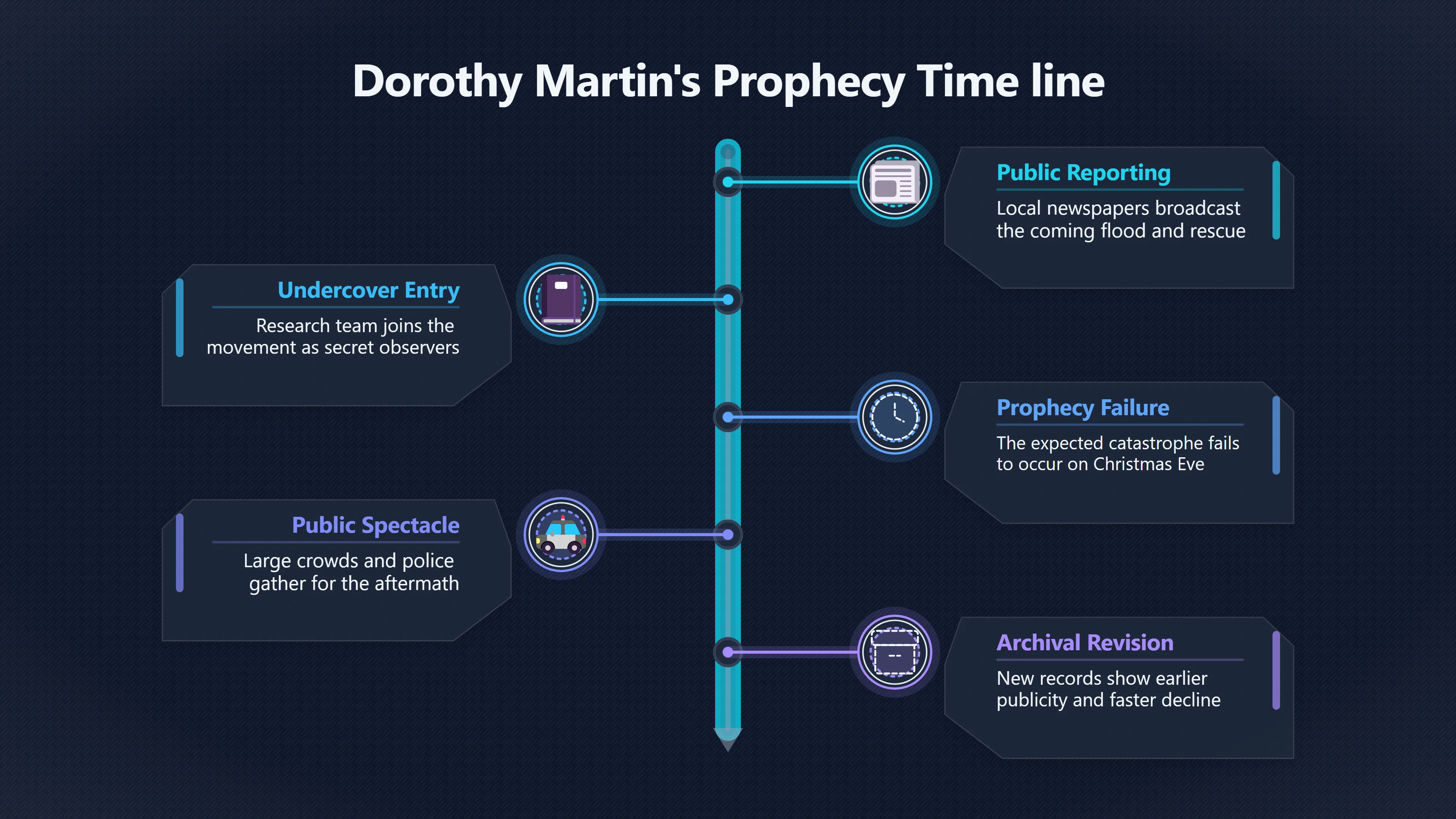
The popular image of Dorothy Martin’s group often suggests a self-contained circle of believers confronting a failed prophecy. In reality, the prediction had become a public event before the crucial date arrived. Local newspapers reported the coming flood and flying-saucer rescue. Journalists monitored developments, neighbours became aware of the group, and the gathering attracted increasing outside attention. Festinger’s research team also entered the movement undercover, posing as believers and observing events from within.[Wikipedia]WikipediaWhen Prophecy FailsWhen Prophecy Fails
This matters because the group’s behaviour unfolded under intense scrutiny. By the time the prophecy failed, believers were not simply responding to a private disappointment. They were responding while surrounded by observers waiting to see what would happen next. Critics of the classic account have argued that the presence of journalists and researchers created conditions that make it difficult to know how the group would have reacted if left alone. Some later analyses note that observers constituted a significant proportion of those present at key moments and may have influenced discussions and decisions.[Wikipedia]WikipediaWhen Prophecy FailsWhen Prophecy Fails
The spectacle continued after the failed prediction. The famous Christmas Eve gathering drew large crowds of spectators and required police attention. Instead of a quiet internal crisis, the event became a public performance in which believers, reporters and onlookers all played roles.[Wikipedia]WikipediaWhen Prophecy FailsWhen Prophecy Fails
A Story Built for Headlines
Martin’s prophecy contained features that naturally attracted media interest:
- A precise date for catastrophe.
- A promised UFO rescue.[pubmed.ncbi.nlm.nih.gov]pubmed.ncbi.nlm.nih.govDebunking "When Prophecy Fails"by T Kelly · 2026 · Cited by 5 — In 1954, Dorothy Martin predicted an apocalyptic flood and promised…
- Ordinary people making extraordinary preparations.
- A visible moment when the prediction could be checked.
For journalists, this structure created a ready-made narrative with anticipation, climax and aftermath. The failure itself became newsworthy because everyone knew when the test would occur. As a result, publicity was not an accidental side effect of the prophecy; it became one of the forces shaping how the episode unfolded and how it was later remembered.[Wikipedia]WikipediaWhen Prophecy FailsWhen Prophecy Fails
Why the Classic Dissonance Story Became Memorable
The enduring fame of Martin’s case owes less to the UFO prediction itself than to what social psychologists believed it demonstrated. Festinger and his colleagues used the episode to develop and illustrate cognitive dissonance theory, the idea that people experience psychological discomfort when reality clashes with strongly held beliefs. The group’s apparent response to failure seemed to provide a vivid real-world example.[Wikipedia]WikipediaWhen Prophecy FailsWhen Prophecy Fails
The narrative was powerful because it was simple. A prophecy failed. Believers did not immediately abandon their faith. Instead, they reportedly reinterpreted events and sought publicity. This appeared to show that commitment could increase after disconfirmation rather than collapse. The story was memorable, teachable, and applicable far beyond UFO movements. It became a standard example in psychology textbooks and discussions of political, religious and ideological belief.[Wikipedia]WikipediaWhen Prophecy FailsWhen Prophecy Fails
Yet the very clarity of the story may have contributed to its longevity. Complex realities were condensed into a dramatic lesson about human psychology. Later scholars have argued that the account emphasised a neat theoretical pattern while downplaying ambiguities, internal differences among believers, and the unusual observational circumstances surrounding the group.[Wikipedia]WikipediaWhen Prophecy FailsWhen Prophecy Fails
The Media-Friendly Version of History
Another reason the story endured is that it offered a compelling moral about belief and evidence. Journalists, educators and writers could easily summarise it: a UFO cult predicted disaster, the disaster failed to occur, and the believers rationalised the failure.
That summary is attractive because it is understandable in a few sentences. The messier details—undercover researchers, observer effects, internal disagreements, and questions about what actually happened afterward—are harder to explain. As often happens with famous historical episodes, the version that travelled furthest was the version that produced the clearest lesson.[The New Yorker]newyorker.comThe theory posits that people experience psychological discomfort when confronted with contradictions between their beliefs and behaviors…
What Later Criticism Changes About the Lesson
The strongest challenge to the traditional account comes from later archival research and methodological criticism. Critics have argued that the famous study overstated both the novelty and extent of the group’s post-failure evangelism. Some newly examined archival materials have been interpreted as showing that members were already engaging in publicity efforts before the prophecy failed and that the movement declined more rapidly afterward than the classic narrative suggests.[Sciety+2PubMed]sciety.orgDebunking "When Prophecy FailsDebunking "When Prophecy Fails" - Sciety5 Oct 2025 — Drawing on newly unsealed archival material, this article demonstrates that th…
Recent scholarship has gone further by questioning whether researchers themselves influenced the events they were studying. Archival evidence discussed by critics suggests that some undercover observers became deeply involved with group members, acquired unusual influence, and may have affected conversations during critical moments. If true, this would complicate claims that the researchers were simply neutral witnesses documenting a natural response to prophetic failure.[The New Yorker+2Wiley Online Library]newyorker.comThe theory posits that people experience psychological discomfort when confronted with contradictions between their beliefs and behaviors…
Methodological critics have raised a broader point: Martin’s group was never operating in isolation. Researchers, reporters and spectators all formed part of the environment. Because of that, the episode may tell us as much about social pressure, public scrutiny and media attention as it does about cognitive dissonance.[Wikipedia]WikipediaWhen Prophecy FailsWhen Prophecy Fails
From Psychology Example to Media Case Study
None of these criticisms necessarily mean that cognitive dissonance is unimportant or that believers never reinterpret failed prophecies. What they do change is the status of Martin’s case as a supposedly clean demonstration of the process.
Viewed through the lens of media spectacle, the episode becomes a more complicated historical event:
- A small UFO movement became a national story.
- Journalists and researchers entered the social world they were observing.
- Public attention altered the stakes of failure.
- Later retellings simplified a complicated sequence into a single psychological lesson.
As a result, Dorothy Martin’s prophecy remains significant not only because a UFO prediction failed, but because the event helped create one of the twentieth century’s most influential stories about belief. The continuing debate is no longer just about whether the group doubled down. It is about how observation, publicity and narrative construction shaped what generations came to think had happened.[The New Yorker+3Wikipedia+3Sciety]WikipediaWhen Prophecy FailsWhen Prophecy Fails
eBay marketplace picks
Marketplace Samples
Example marketplace items related to this page. Use the search link to explore similar finds on eBay.



Endnotes
1.
Source: Wikipedia
Title: When Prophecy Fails
Link:https://en.wikipedia.org/wiki/When_Prophecy_Fails
2.
Source: sciety.org
Title: Debunking “When Prophecy Fails”
Link:https://sciety.org/articles/activity/10.31235/osf.io/9j7qc_v2
Source snippet
Debunking "When Prophecy Fails" - Sciety5 Oct 2025 — Drawing on newly unsealed archival material, this article demonstrates that th...
3.
Source: onlinelibrary.wiley.com
Title: Online Library Debunking “When Prophecy Fails”
Link:https://onlinelibrary.wiley.com/doi/abs/10.1002/jhbs.70043
Source snippet
[Notes by Riecken] (Leon Festinger papers). Ann Arbor, Michigan...Read more...
4.
Source: newyorker.com
Link:https://www.newyorker.com/culture/the-lede/is-cognitive-dissonance-actually-a-thing
Source snippet
The theory posits that people experience psychological discomfort when confronted with contradictions between their beliefs and behaviors...
5.
Source: pubmed.ncbi.nlm.nih.gov
Link:https://pubmed.ncbi.nlm.nih.gov/41186060/
Source snippet
Debunking "When Prophecy Fails"by T Kelly · 2026 · Cited by 5 — In 1954, Dorothy Martin predicted an apocalyptic flood and promised...
6.
Source: books.google.com
Title: When Prophecy Fails
Link:https://books.google.com/books/about/When_Prophecy_Fails.html?id=pknuAAAAMAAJ
Source snippet
would these people feel when their prophecy remained unfulfilled? Would they admit the error of their prediction, or woul...
Additional References
7.
Source: christianscholars.com
Link:https://christianscholars.com/when-the-book-about-when-prophecy-fails-fails-the-lies-behind-the-famous-theory-of-cognitive-dissonance/
Source snippet
When the Book about When Prophecy Fails Fails: The Lies...1 Apr 2026 — The book is based on the account of Dorothy Martin, who in 1954 p...
8.
Source: voices.uchicago.edu
Title: encountering when prophecy fails encountering cognitive dissonance
Link:https://voices.uchicago.edu/religionculture/2015/09/01/encountering-when-prophecy-fails-encountering-cognitive-dissonance/
Source snippet
UChicago VoicesEncountering When Prophecy Fails...1 Sept 2015 — Cognitive Dissonance and Persistent Longing in an Age Psychological.” T...
9.
Source: andzwa.medium.com
Title: cognitive dissonance and doomsday cults 785c9403cae5
Link:https://andzwa.medium.com/cognitive-dissonance-and-doomsday-cults-785c9403cae5
Source snippet
Dissonance and Doomsday Cults | by Andy WalkerIt's a story of a 1950s cult called the Seekers led by a lady called Dorothy Martin who had...
10.
Source: gwern.net
Link:https://gwern.net/doc/psychology/cognitive-bias/2025-kelly.pdf
Source snippet
roup mem- bers from that put forth in When Prophecy...Read more...
11.
Source: skepticalscience.com
Title: The Person Who Lies To You The Most…
Link:https://skepticalscience.com/print.php?n=5174
Source snippet
Is You8 Sept 2021 — Fascinatingly, when the prophecy failed, rather than admit they were wrong, the Seekers became more convinced they we...
12.
Source: theatlantic.com
Title: the christmas the aliens didnt come
Link:https://www.theatlantic.com/health/archive/2015/12/the-christmas-the-aliens-didnt-come/421122/
Source snippet
The Christmas the Aliens Didn't Come18 Dec 2015 — The Christmas the Aliens Didn't Come. What a failed doomsday prophecy taught psychologi...
13.
Source: scribd.com
Title: Debunking When Prophecy Fails
Link:https://www.scribd.com/document/987665255/Debunking-When-Prophecy-Fails
Source snippet
PDFThis article critiques the influential 1956 book 'When Prophecy Fails' by Festinger et al., which claimed that a UFO cult doubled down...
14.
Source: lesswrong.com
Title: debunking when prophecy fails
Link:https://www.lesswrong.com/posts/qth5r82ZhMEXzc25y/debunking-when-prophecy-fails
Source snippet
Debunking “When Prophecy Fails”6 Nov 2025 — The documents reveal that the group actively proselytized well before the prophecy failed and...
15.
Source: alexquigley.co.uk
Title: when prophecies fail and evidence backfires
Link:https://alexquigley.co.uk/when-prophecies-fail-and-evidence-backfires/
Source snippet
gnitive dissonance and backfiring emotions. Of course, Martin miraculously managed to...Read more...
16.
Source: youtube.com
Title: When Prophecy Fails — The System Behind Doubling Down
Link:https://www.youtube.com/watch?v=yJ3ilyecMBU
Source snippet
When the World Didn't End: 10 Doomsday Cults That Got It Totally Wrong...
Topic Tree